

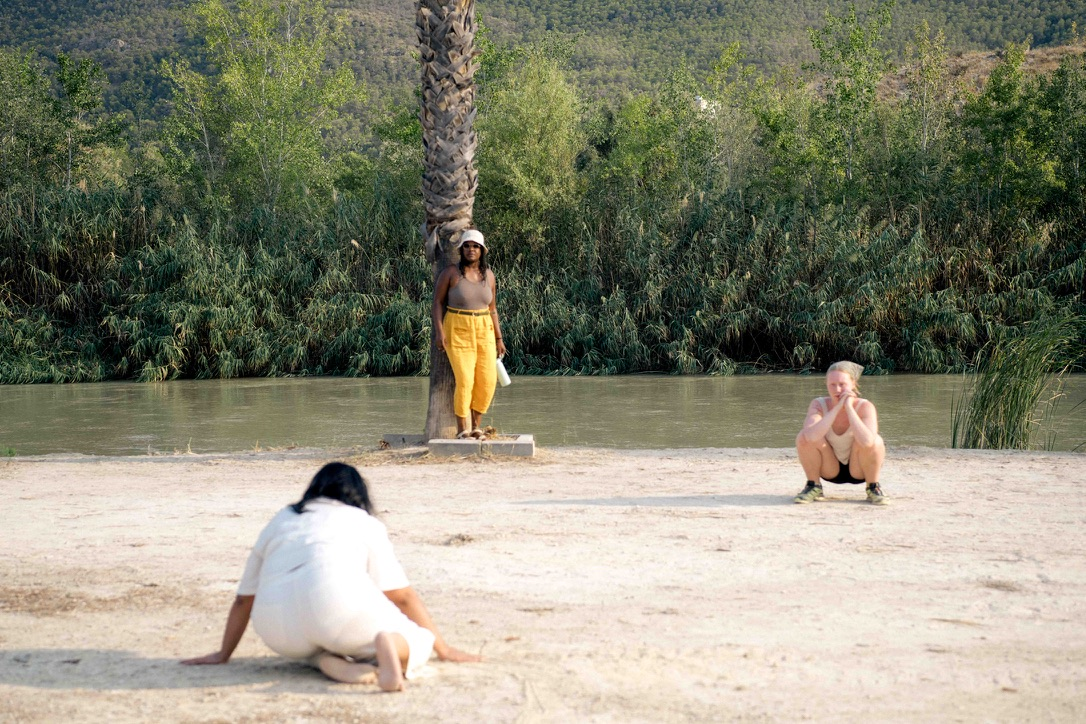
How I Did an Artist Residency with My 2-Year-Old (and Accidentally Became a Performance Artist in Survival Mode)
There are many things I learnt soon after becoming a mom. One of the lessons that took me a back—and crept up from behind like an unsolicited philosophical insight at 3 a.m.—was that returning to work after childbirth is harder than starting the job for the first time. Or at least that was my experience.
There are so many factors to consider, as you are now simultaneously providing care to a dependent human being while attempting to re-enter a professional identity you once believed was stable and fully installed. In reality, it turns out to be more like an operating system update that never quite finishes, while several background processes (feeding, soothing, negotiating with a tiny irrational diplomat) continue to run at full capacity.
Because of this, you may not be able to keep up with your peers in the way you once did. You often feel left behind, or exhausted, or distracted, or like your attention has been permanently split into uneven fragments. And because of this fragmentation, you feel different.
This is not a comfortable feeling—especially when you still carry a strong internal image of yourself as you were before: faster, more efficient, mildly smug about your ability to answer emails in under three minutes. In your mind, you are still that self. But in reality, something has shifted in both your bandwidth and your relationship with time itself. You have changed, whether or not your self-concept has signed the necessary consent forms.
This becomes the first real existential challenge after returning to work: reconciling identity memory with current operating conditions.
For me, as an artist, there are varied forms of work beyond the traditional desk job, which theoretically offers flexibility and creatively optimistic life arrangements. So when I was invited to a month-long artist residency, I decided to join—armed with enthusiasm, artistic ambition, and, as it turned out, a 2-year-old who had strong opinions about spatial autonomy, hydration schedules, and my ability to concentrate on anything other than snack distribution.
This was, in theory, an opportunity to return to deep creative work. To think. To make. To sit in silence and commune with ideas like an enlightened European painter in a cinematic slow zoom shot.
In practice, I arrived with a 2-year-old.
Which meant I was not entering an “artist residency” so much as a site-specific endurance performance piece titled: Material Practice Under Conditions of Constant Snack Negotiation.
The residency was hosted by an old friend and performance artist, Raegan Traux, who was helming a performance art residency program in Blanca, Spain, in collaboration and cooperation with AADK Spain. It sounded perfect, almost suspiciously so—I would get to spend time and work alongside someone I knew and trusted, which meant taking my daughter along didn’t feel as structurally catastrophic as it might have otherwise. I knew there would be support. I also knew we were going to be provided a family apartment with air conditioning, which, given we were travelling in September, felt less like a luxury and more like a basic ethical requirement for human survival.
September arrived sooner than expected, as time tends to do when you are simultaneously over-preparing and under-sleeping. My daughter and I flew to Blanca.
The site of the residency turned out to be at AADK Spain—which, I quickly learned, involved a literal uphill climb. And when I say uphill, I mean the kind of incline that makes you reconsider all prior life decisions, including but not limited to: motherhood, artistic practice, and the invention of gravity.
My first challenge presented itself immediately. I had to drag a pushchair (and a fully operational toddler) up a mountain in the hot afternoon sun, after a two-hour flight, with a child whose emotional regulation system had also clearly not been updated post-flight.
First learning: you are no longer in the comfort of your home environment, and therefore should assume that physics, patience, and dignity will all be renegotiated on arrival.
Of course, it was doable—but “doable” in this context is a very philosophical term. I was now responsible for both entering a new artistic environment and ensuring that my toddler did not interpret this relocation as an elaborate form of emotional betrayal.
As a parent, I also found myself actively trying to ensure that this was not a traumatic experience for my child. Which meant that while I was adjusting to a new residency, new landscape, and new artistic framework, I was simultaneously running a parallel emotional monitoring system: Is she okay? Am I projecting calm? Does she think we’ve been abandoned on a Spanish mountain for conceptual reasons?
In short, I had not just arrived at an artist residency.
I had arrived with a dependent co-artist whose main medium was immediate feedback and very loud critique.
The settling-in phase was a challenge, but also quite essential. I needed to locate the closest grocery store, pharmacy, playground, and cafés—as if I were mapping a small ecosystem for survival rather than simply arriving at an artist residency. In addition, going up and down the mountain quickly established itself as a constant and very present philosophical reality, one that politely refused to become easier with repetition.
The first weekend passed surprisingly fast. We spent mornings at the park, afternoons indoors for siesta (a forced but dignified surrender to heat and fatigue), and evenings back at the park again. I was trying my best to create a sense of familiarity for my daughter, as if repetition could function as emotional architecture. The next two weeks were about to be full days of body-based exercises and deep work, so I needed her to feel at home—or at least convincingly unconcerned by geography.
Over the weekend, one by one, the rest of the artists arrived at the residency site. Since we were the first to arrive, I got a front-row seat to the arrival choreography of each new participant. And—purely observationally, of course—I noticed that everyone struggled with the climb. Much to my completely unbiased satisfaction, the mountain did not discriminate. It humbled all equally.
We had a wonderful first day of orientation and introductions. My daughter, as always, was the undisputed star of the evening. She made friends with impressive speed, as if social bonding were a performance piece she had been rehearsing in secret. I, meanwhile, was delighted to discover that this was a genuinely warm and interesting group of artists.
Second learning: networking while parenting is a very different cognitive exercise. You are simultaneously trying to engage in conversations about art, research, and intellectual frameworks, while running a parallel real-time safety protocol involving a small human being and her evolving relationship with gravity.
I found myself split between two modes of consciousness: the artist-self, attempting to discuss ideas, intentions, and conceptual inquiry; and the parent-self, whose primary concern was whether my child was currently testing the tensile strength of a nearby rock and therefore one microsecond away from an irreversible lesson in physics.
So there I was, oscillating between reflections on artistic practice and a very practical internal monologue that sounded suspiciously like: stay close, don’t fall, not that rock, why that rock, please reconsider the rock.
In that space, I began to understand something quite clearly: at this residency, I was not only practicing art.
I was also practicing continuous, high-alert attention—on everything, all at once.
The next two weeks were entirely designed by Raegan, where during the week we would do early morning hikes, followed by a structured sequence of emotive exercises, studio sessions, and writing practices. Everything was carefully scheduled across different parts of the day, in an attempt to align artistic labour with the natural rhythm of light and heat—specifically to avoid the most aggressive version of the Spanish sun.
It was a well-thought-out structure. And yet, even within that careful design, the physical intensity of it was still very real. There is something humbling about being told that your creative process includes both “deep emotional excavation” and “a mountain hike before breakfast.” One quickly learns that embodiment is not just a concept; it is also slightly out of breath.
Here I need to mention that my earlier decision to communicate openly that I would be bringing my child to the residency made a significant difference. It shifted the expectations early, rather than arriving later with unspoken negotiations disguised as logistical surprises.
Third learning: open communication of your needs and expectations is essential when attempting anything that involves both art-making and the coordination of dependent human life. It turns out transparency is not just an ethical preference—it is also a practical survival tool.
In the last two weeks, my husband joined us, as during the third week I needed additional support in order to be able to leave my daughter at the apartment while I engaged in longer hours of work and preparation for our final performance. Without that support structure, the residency would have quietly collapsed into a very different kind of performance practice—one involving constant interruption, negotiation, and snack diplomacy.
My initial instinct, artistically, was to directly translate my experience as a mother into the work itself. This felt both natural and, in many ways, compelling, since I was the only participant in the program navigating this specific condition of motherhood alongside artistic production. It would have been easy—and perhaps even expected—to turn that into the central material.
But I began to question whether that approach was actually necessary for the kind of work I wanted to make.
Here is why: for me, making art is not about directly reflecting or infusing everyday experience into form as a straightforward translation. Art, in my practice, functions more as a tool for deeper inquiry—less a mirror of what is already visible, and more a method for arriving at what is not yet understood.
This is not to say that lived experience is irrelevant. Rather, it is not always the raw material in its immediate form. Sometimes it needs to be metabolised—digested through attention, distance, and curiosity—before it becomes meaningful within a creative framework.
For some practices, direct translation is the method. For mine, it is not.
I need to go inward, but also outward; to allow experience to pass through me rather than simply be reproduced by me. To remain open to what I feel, what I see, and what I do not yet know more than what I already understand.
Fourth learning: art is not about what you already know, but what you are willing to inquire into. It is about cultivating curiosity as a discipline, and training the mind to stay inquisitive about life, perception, and one’s place within a larger, constantly unfolding system—cosmic, chaotic, and occasionally interrupted by childcare logistics.
This residency was never just an artistic retreat—it was a continuous negotiation between intention and reality, between the structured language of artistic practice and the unpredictable, un-annotated demands of life unfolding in real time.
I arrived thinking I would be entering a space of focused creation. What I actually entered was a layered experience of adaptation: to geography, to intensity, to community, and most significantly, to a version of myself that no longer operates in uninterrupted solitude.
What I learned was not how to separate motherhood from art, or even how to balance the two in a neatly resolved way. Instead, I learned that both exist in the same field of attention—sometimes competing, sometimes collapsing into each other, and sometimes unexpectedly enriching one another in ways that cannot be pre-planned or neatly articulated.
There is a certain humility in working under conditions that refuse to idealise your time or protect your focus. It forces a different kind of intelligence—less linear, more responsive; less controlled, more attuned.
And perhaps most importantly, it redefined what I thought artistic work required from me. Not perfection of conditions, but presence within imperfect ones. Not isolation from life, but a deeper inquiry into how life itself shapes perception, rhythm, and thought.
So I did not return from the residency with a resolved equation.
I returned with a more honest one: that creative practice is not separate from the conditions it occurs in—it is continuously rewritten by them.

Written by - Natasha Jozi
Hi, I’m Natasha—an artist from Pakistan who once imagined a life full of creativity, curiosity, and beautifully unpredictable experiences. Technically, I got exactly what I asked for… just not in the way I expected. Three years ago, I became a mom and moved to Germany—entering a new era of life best described as: an infinite loop of laundry, dishes, cleaning, and existential reflection (usually all at once). At some point, I started wondering if this was a glitch in the system—or just… the system. But somewhere between folding tiny socks and reheating my coffee for the third time, I realized two things: one, I’m not the first person to be humbled by daily life, and two, chaos becomes far more manageable when you learn to design around it. This blog is my attempt to do exactly that—make sense of the mess, romanticize the mundane, and build a life (and self) that actually works.
Leave a Reply